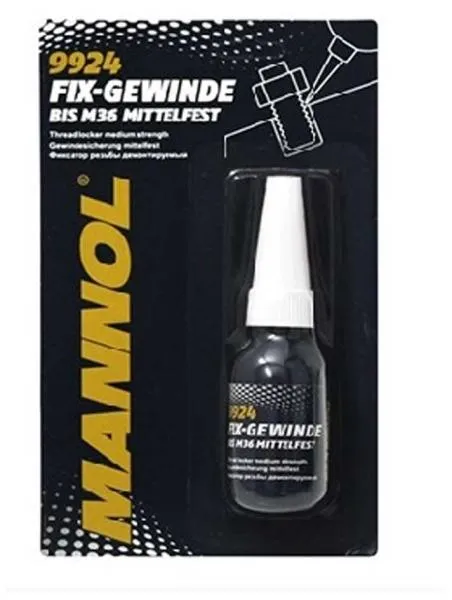

MANNOL HPA THREADLOCKER – MEDIUM
Mannol medium-strength threadlocker (for example, Mannol Fix-Gewinde Mittelfest 9924) is an anaerobic threadlocker with the following main features:
- Medium strength: This means the secured joint is strong enough to prevent loosening from vibration and load but can still be undone with ordinary hand tools when necessary.
- Vibration resistance: Prevents screws, nuts and other threaded fasteners from loosening.
- Sealing effect: Fills small gaps between threads, sealing them against leaks of oil, water, fuel, air and other fluids.
- Corrosion prevention: Protects threads against rust.
- Heat resistance: Generally suitable for temperatures from -55°C to +150°C.
- Thread size: Usually recommended up to M36 thread size.
- Torque resistance: With M10 threads, withstands approximately 20 Nm of torque (this may vary for the specific product).
- Uses: Also suitable for securing bearings, support bolts, studs and plugs. Can be used on greasy surfaces and galvanized threads.
Application:
Apply the threadlocker evenly to the bolt and nut threads. Bonding starts in 10-20 minutes and full curing may take 1-3 hours. The product cures anaerobically, that is, in the absence of air.
In summary, Mannol medium-strength threadlocker is suitable where reliable resistance to vibration is important but the joint must remain removable later.
What is an HPA system?
HPA is a propulsion system for airsoft guns that uses compressed air to fire BBs. Unlike traditional electric (AEG) or gas (GBB) systems, HPA requires an external compressed-air source connected to the gun by a hose.
Main parts of an HPA system:
- Compressed-air tank (HPA bottle): This stores high-pressure air (usually 3000 or 4500 PSI). Tanks are available in different sizes, affecting the number of shots available and the system’s weight.
- Pressure regulator: This reduces the tank’s high pressure to a lower pressure suitable for operating the gun (usually between 40-160 PSI). The output pressure of most regulators can be adjusted.
- Hose (HPA line): A high-pressure hose connecting the regulator to the HPA engine installed in the gun.
- HPA engine: This mechanism installed in the gun meters the air and fires the BB. Different types have different operating principles (e.g. piston or valve). They often have an electronic fire control unit (FCU – Fire Control Unit) for adjusting firing modes (single, burst, full auto), rate of fire (ROF – Rate of Fire) and other parameters.
How an HPA system works:
Compressed air passes from the tank through the regulator and hose into the HPA engine at the set low pressure. When the player pulls the trigger, the engine admits the appropriate amount of air into the chamber according to the control unit’s instructions, propelling the BB through the barrel.
Advantages of HPA systems:
- Consistent performance: HPA systems are less sensitive to temperature changes than gas systems, so shot velocity (FPS – Feet Per Second) remains much more stable.
- Adjustable performance: The desired output pressure can be set easily through the regulator, allowing gun performance to be fine-tuned to game rules or playing style.
- Quieter operation: Many HPA engines run more quietly than AEGs, particularly at high rates of fire.
- High rate of fire: HPA systems can achieve very high rates of fire if the engine and control unit support it.
- Low maintenance requirements: HPA engines generally have fewer moving parts than AEGs, reducing the chance of failure and simplifying maintenance.
- Potential for “joule creep”: With certain settings and heavier BBs, HPA systems may exhibit “joule creep”, delivering more energy with heavier BBs. Most airsoft rules, however, restrict or prohibit this.
Disadvantages of HPA systems:
- Higher initial cost: Buying an HPA system (tank, regulator, hose, engine) is generally more expensive than an entry-level AEG or GBB replica.
- Need for an external air source: The player has to carry the compressed-air tank, which can be inconvenient and affect mobility. The hose can also restrict movement.
- Filling the tank: The tank must be refilled regularly with compressed air, which may require a dedicated filling station or compressor.
- Complexity: Setting up and fine-tuning HPA systems may be more complicated for beginners.
- Safety requirements: Working with high-pressure air requires extra care and compliance with safety requirements.





Reviews
There are no reviews yet.