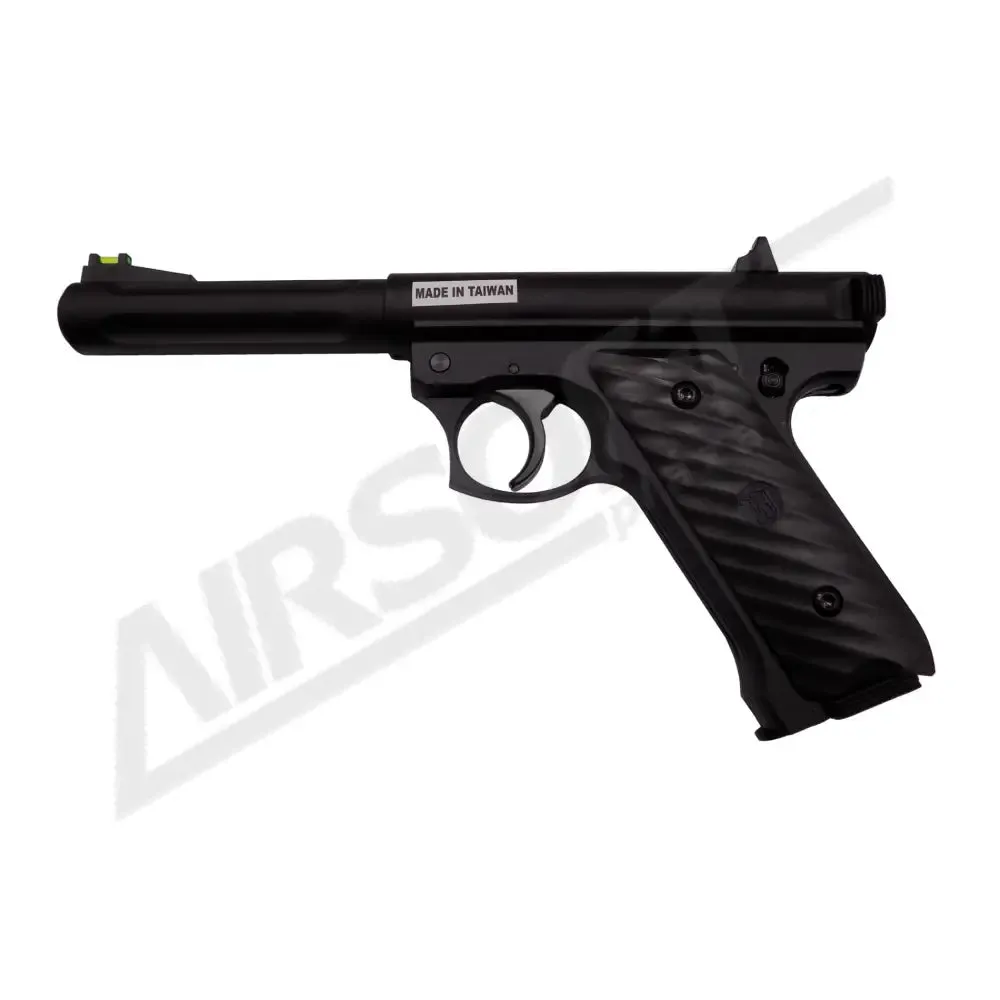

Real firearm version:
The brief history of Ruger is a typical American success story. A few years after World War II, two young men from Connecticut, William B. Ruger and Alexander M. Sturm, decided to start a business with fifty thousand dollars in a barn beside the Southport railway station. Ignoring skeptical comments that trying to manufacture guns in a saturated market was money thrown away, they began experimenting with cheap casting and metalworking methods. At first they supplied only small dealers with simple tools, although some of these looked more like firearm prototypes than ordinary do-it-yourself tools.
Like its predecessor, the Mark II was a sure success in the USA, due in significant part to the manufacturer offering 18 variants to satisfy every possible use (plinking, sport, hunting, training and self-defense). Its popularity is reflected in the fact that companies making special parts and upgrades (e.g. Volquartsen, Clark Custom Guns, Cylinder and Slide) offered at least fifty configurations.
Standard models have fixed sights and a traditional barrel that tapers toward the muzzle, reminiscent of a Luger. The Target and Government models with adjustable sights can also be bought with heavy bull barrels, giving the pistols a distinctive appearance. The Competition has an angular-profile barrel, a rail suitable for mounting an optical sight and wooden grip panels. The guns are made with seven barrel lengths ranging from 10-25 cm, and target sights can be changed on the heavy barrels. This broad selection alone would have meant little if Rugers, despite their many mostly stamped-metal parts, had not proved sufficiently strong and reliable. The substantial safety margins are evident, for example, in the exceptionally large-diameter barrel breech or, after disassembly, the robust firing pin.

Reviews
There are no reviews yet.