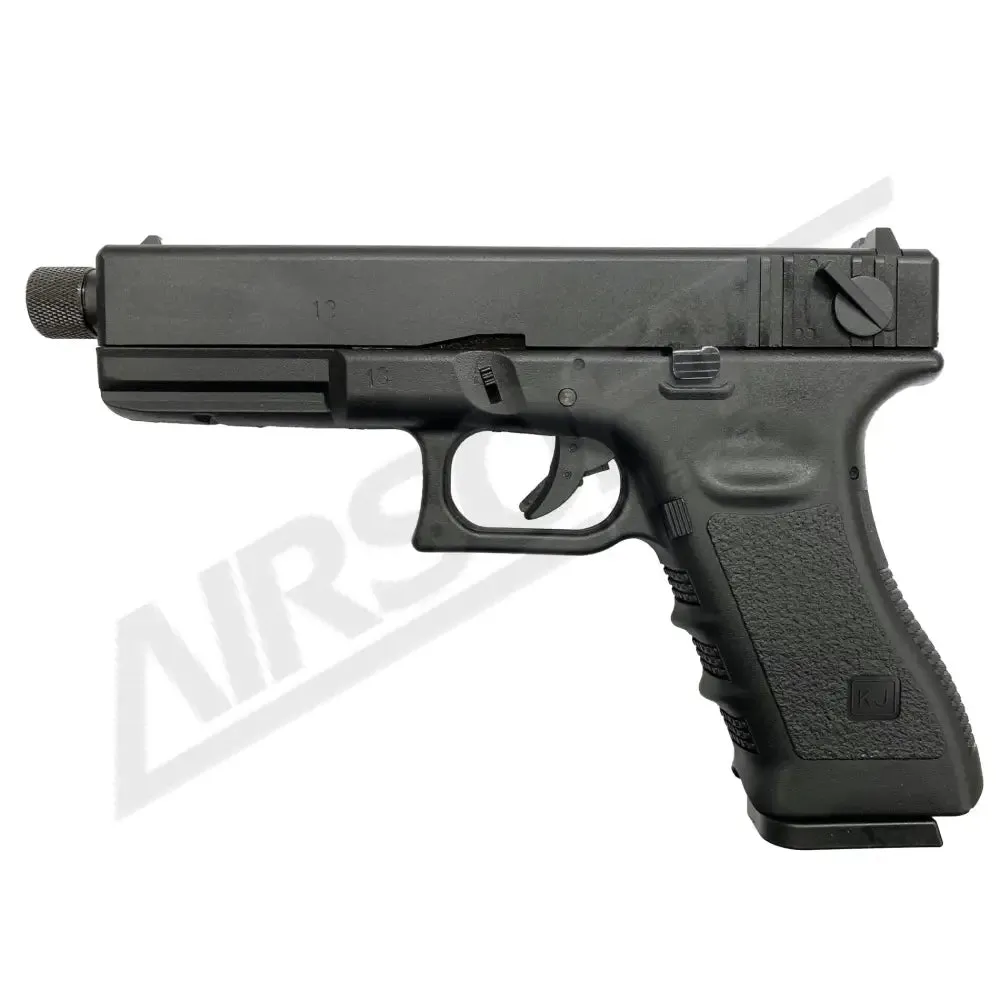

Real firearm version:
GLOCK was founded by engineer Gaston Glock in 1963 in Deutsch-Wagram near Vienna. Its main business was the production of plastic, plastic-embedded steel and steel structures. The company quickly recognized the potential of steel structures embedded in plastic, especially in products intended for military use, and soon began supplying plastic buckles, machine-gun belts, training hand grenades, combat knives and a combined entrenching tool to the Austrian army. In the early 1980s, the Austrian army planned to introduce a modern, reliable, lightweight service pistol and requested proposals from several Austrian and foreign firearms manufacturers. GLOCK Ges.m.b.H., which had performed its earlier military supply work very well, was also invited to the tender.
This presented a new challenge for the company, since at that time it did not manufacture firearms at all. An advantage was that it did not have to modify existing models. In addition to his other patents, Mr. Glock was able to design a revolutionary new pistol. With a plastic frame and parts, the GLOCK was lighter than its competitors and therefore easier to carry, and it had the largest magazine capacity. The pistol had no external safety, hammer, decocker or other part that had to be activated before firing. Mr. Glock and his colleagues produced a pistol that could be made ready faster than any competitor’s, had fewer parts and was safer to handle.
This new construction allowed the shooter to focus on tactical tasks rather than on operating (activating) the safeties on the gun.
Overall, the pistol combined two systems: the simple handling characteristic of a revolver in the first GLOCK 17 and the higher magazine capacity and faster reloading of self-loading pistols. The result was the SAFE ACTION SYSTEM safety mechanism. When the trigger is activated, a three-stage safety (trigger, firing-pin and drop safety) releases automatically, and locks again when the trigger is released. The prototype design worked well, and after only four additional prototypes, serial production of the GLOCK 17 (9X19 mm) began. Test examples were sent to the Austrian army, and after it passed every test successfully, GLOCK won the tender! Shortly afterward, the Austrian army and police adopted the GLOCK 17 as a service weapon.
Airsoft version:
Like the real firearm, the airsoft Glock is known for its reliability. KJW fitted its KP-03 series with an aluminum slide, so external impacts have relatively little effect on the pistol. The frame is made from strong polymer. Its light slide makes it gas-efficient: approximately 3-4 magazines can be fired with it, depending of course on the current temperature.

Reviews
There are no reviews yet.