
Live-fire version:
The GLOCK company was founded by engineer Gaston Glock in 1963 in Deutsch-Wagram near Vienna. Its main line of business was the production of plastic, plastic-embedded steel and steel structures. The company quickly recognised the potential of plastic-embedded steel structures, which were particularly desirable for military products, and soon began supplying plastic buckles, machine-gun slings, practice hand grenades, field knives and combination entrenching tools to the Austrian army. In the early 1980s, the Austrian army planned to introduce a modern, reliable, lightweight service pistol and requested proposals from several Austrian and foreign firearms manufacturers. GLOCK Ges.m.b.H., which had performed its previous military supply contracts excellently, was also invited to the tender.
This presented a new challenge for the company because it did not manufacture firearms at the time. The company had the advantage that it did not have to modify existing models. Alongside his other patents, Mr Glock was able to design a revolutionary new pistol. With a plastic frame and components, the GLOCK was lighter than its competitors and therefore easier to carry, and it had the largest magazine capacity. The pistol had no external safety, hammer, decocker or other element that had to be activated before firing. Mr GLOCK and his colleagues produced a pistol that could be brought into action faster than any competitor, had fewer parts and could be handled more safely.
This new design allowed the shooter to concentrate on tactical tasks instead of operating or activating safeties fitted to the weapon.
Overall, the pistol combined two systems: the simple operation characteristic of a revolver in the first GLOCK 17, and the larger magazine capacity and fast reloading of self-loading pistols. This resulted in the safety mechanism known as the SAFE ACTION SYSTEM. When the trigger is activated, the three-stage safety system (trigger, firing-pin and drop safety) disengages automatically and then locks again when the trigger is released. The prototype design worked well, and series production of the GLOCK 17 (9X19 mm) began after only four further prototypes. Test examples of the weapon were sent to the Austrian army and, after successfully passing every test, GLOCK won the tender! Shortly afterwards, the Austrian army and police adopted the GLOCK 17 as a service weapon.
Airsoft version:
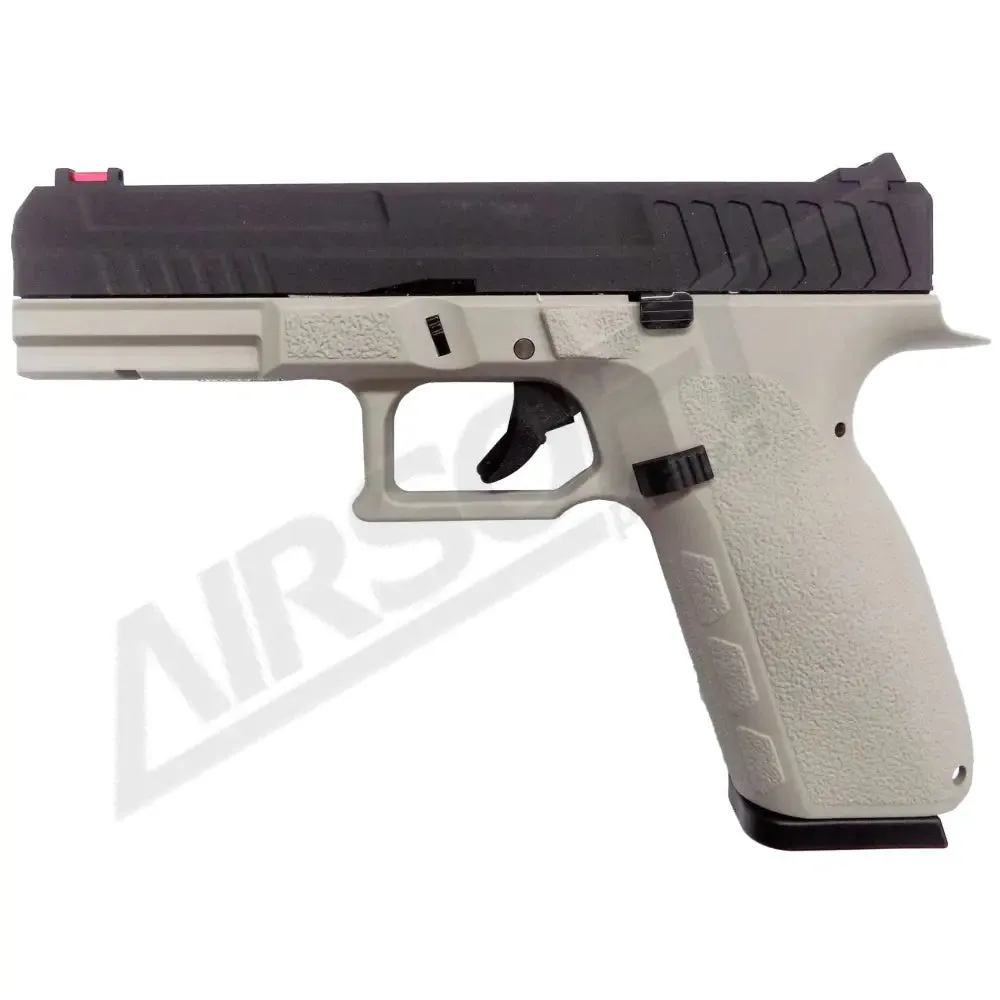
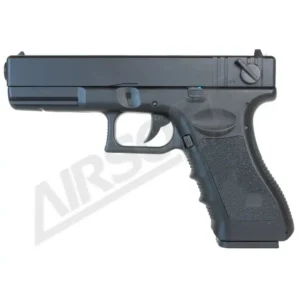
As with the live-fire weapon, Glock is also known for reliability in the airsoft version. KJW equipped its KP-13 series with an aluminium slide, so external impacts do not have too much effect on the pistol. The frame is made from strong polymer. Its lightweight slide makes it gas-efficient, allowing approximately 3-4 magazines to be fired, although this naturally depends on the current temperature.

Reviews
There are no reviews yet.