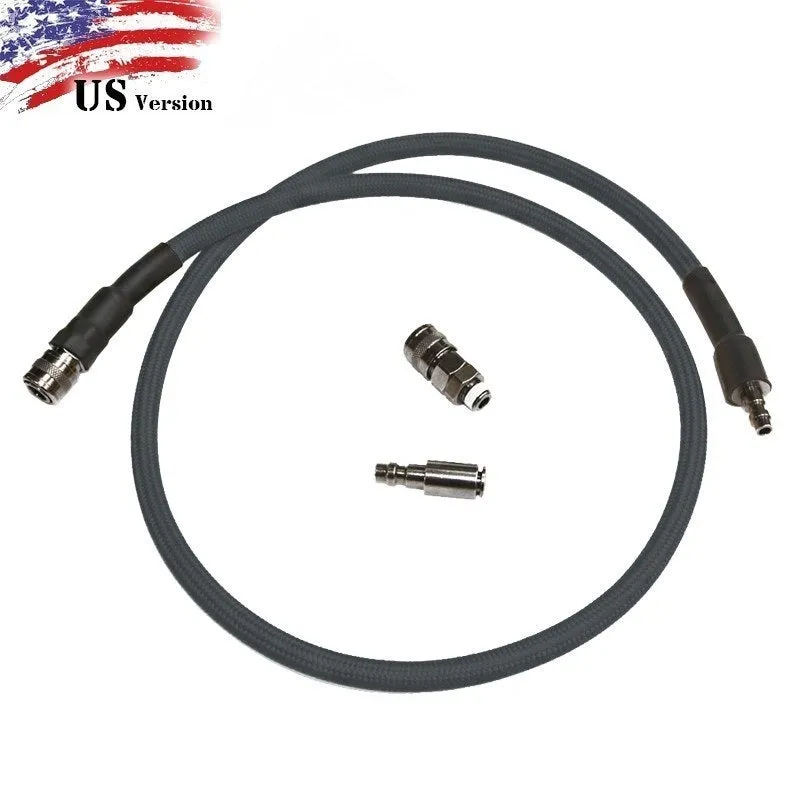

BALYSTIK COMPLETE HPA BRAIDED US LINE – GREY
The Balystik product range has two female-threaded quick connectors that immediately shut off the air when disconnected. One is at the end of the regulator, and the other is at the end of the hose. This lets you disconnect your gun while retaining pressure in the hose, or disconnect the hose from the regulator while retaining pressure in the regulator. The connection and disconnection system is extremely fast, reliable, and economical in its use of air. The package contains everything needed to connect a regulator with a 1/8 NPT female thread to a 6 mm macro hose for use with HPA systems such as Wolverine, Polarstar, and Valken HPA gearboxes.
- Hose outer diameter: 8 mm
- Hose length: 1 meter
- Material: Braided nylon
- Maximum inlet pressure: 180 PSI
- Connector type: US version
We strongly recommend using a mild threadlocker on the regulator’s 1/8 NPT thread instead of PTFE/Teflon tape to ensure a perfect seal.
Data sheet:
- Length (mm): 1000
- Weight: 150 grams
- HPA connector type: US
- Output pressure: Maximum 180 PSI
What is an HPA system?
HPA is a propulsion system for airsoft guns that uses compressed air to fire BBs. Unlike conventional electric (AEG) or gas (GBB) systems, HPA requires an external compressed-air source connected to the gun by a hose.
Main components of an HPA system:
- Compressed-air tank (HPA cylinder): This stores high-pressure air (usually 3000 or 4500 PSI). Tanks are available in different sizes, which affects the number of shots available and the weight of the system.
- Pressure regulator: This component reduces the high pressure in the tank to a lower pressure suitable for operating the gun (usually between 40-160 PSI). The output pressure is adjustable on most regulators.
- Hose (HPA line): A high-pressure hose that connects the regulator to the HPA engine installed in the gun.
- HPA engine: This mechanism installed in the gun controls the delivery of air and fires the BB. Different types exist, based on different operating principles (e.g. piston-operated or valve-operated). They often have an electronic control unit (FCU – Fire Control Unit) that allows adjustment of firing modes (single, burst, full auto), rate of fire (ROF – Rate of Fire), and other parameters.
How an HPA system works:
Compressed air flows from the tank through the regulator, then through the hose to the HPA engine at the set lower pressure. When the player pulls the trigger, the engine, following instructions from the control unit, admits the appropriate amount of air into the chamber, propelling the BB through the barrel.
Advantages of HPA systems:
- Consistent performance: HPA systems are less sensitive to temperature changes than gas systems, so shot velocity (FPS – Feet Per Second) remains much more stable.
- Adjustable power: The desired output pressure can be easily set through the regulator, allowing the gun’s power to be fine-tuned to the game rules or playing style.
- Quieter operation: Many HPA engines operate more quietly than AEGs, especially at high rates of fire.
- High rate of fire: HPA systems can achieve a very high rate of fire if the engine and control unit support it.
- Low maintenance requirements: HPA engines generally have fewer moving parts than AEGs, reducing the chance of failure and making maintenance simpler.
- Potential for “joule creep”: With certain settings and heavier BBs, HPA systems may exhibit “joule creep”, meaning they deliver more energy with heavier BBs. However, most airsoft rules restrict or prohibit this.
Disadvantages of HPA systems:
- Higher initial cost: Purchasing an HPA system (tank, regulator, hose, engine) is generally more expensive than purchasing an entry-level AEG or GBB replica.
- Need for an external air source: The player must carry the compressed-air tank, which can be inconvenient and affect mobility. The hose can also restrict movement.
- Filling the tank: The tank must be refilled regularly with compressed air, which may require a special filling station or compressor.
- Complexity: Setting up and fine-tuning HPA systems may be more complicated for beginners.
- Safety requirements: Working with high-pressure air requires extra care and compliance with safety requirements.




Reviews
There are no reviews yet.