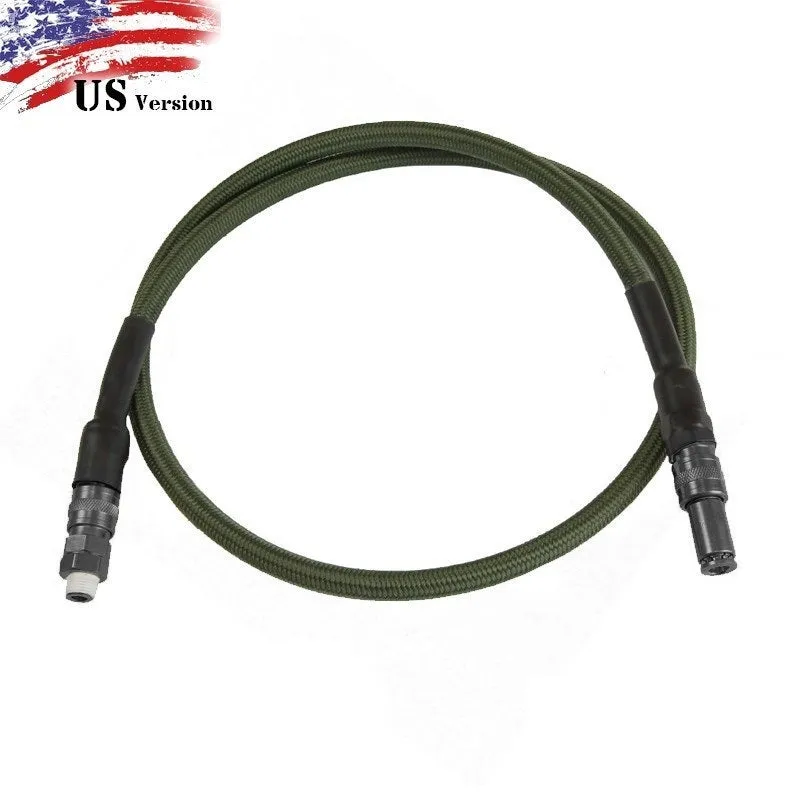

BALYSTIK COMPLETE HPA LINE WITH BRAIDED COVER, US – OD
The Balystik product range has two female-thread quick connectors that shut off the air immediately upon disconnection. One is at the regulator end and the other at the hose end. This lets you disconnect your gun while pressure remains in the hose, or disconnect the hose from the regulator while pressure remains in the regulator. The connect/disconnect system is very fast, reliable and economical in its use of air. The package includes everything needed to connect a regulator with a 1/8 NPT female thread to a 6 mm macro hose, for use with HPA systems such as Wolverine, Polarstar and Valken HPA gearboxes.
- Hose outer diameter: 8 mm
- Hose length: 1 metre
- Material: Braided nylon
- Maximum input pressure: 180 PSI
- Connector type: US version
Using a mild thread locker on the 1/8 NPT regulator thread rather than PTFE/Teflon tape is strongly recommended for a perfect seal.
Data sheet:
- Length (mm): 1000
- Weight: 150 grams
- HPA connector type: US
- Output pressure: Maximum 180 PSI
What is an HPA system?
HPA is a propulsion system for airsoft guns that uses compressed air to fire BBs. Unlike traditional electric (AEG) or gas (GBB) systems, HPA requires an external compressed-air source connected to the gun by a hose.
Main components of an HPA system:
- Compressed-air tank (HPA tank): This stores high-pressure air (usually 3000 or 4500 PSI). Tanks are available in different sizes, affecting the number of shots available and the weight of the system.
- Pressure reducer (regulator): This component reduces the high tank pressure to a lower pressure suitable for operating the gun (usually between 40-160 PSI). Output pressure is adjustable on most regulators.
- Hose (HPA line): A high-pressure hose that connects the regulator to the HPA engine installed in the gun.
- HPA engine: This mechanism installed in the gun controls air delivery and fires the BB. Different types exist based on different operating principles (e.g. piston or valve). They often have an electronic control unit (FCU – Fire Control Unit), which allows adjustment of firing modes (single, burst, full auto), rate of fire (ROF – Rate of Fire) and other settings.
How the HPA system works:
Compressed air passes from the tank through the regulator at the selected lower pressure, then through the hose into the HPA engine. When the player pulls the trigger, the engine admits the appropriate amount of air into the chamber according to instructions from the control unit, propelling the BB through the barrel.
Advantages of HPA systems:
- Consistent performance: HPA systems are less sensitive to temperature changes than gas systems, so shot velocity (FPS – Feet Per Second) remains much more stable.
- Adjustable power: The desired output pressure can easily be set through the regulator, allowing gun performance to be fine-tuned to field rules or playing style.
- Quieter operation: Many HPA engines operate more quietly than AEGs, especially at high rates of fire.
- High rate of fire: HPA systems can achieve very high rates of fire if the engine and control unit support it.
- Low maintenance requirement: HPA engines generally have fewer moving parts than AEGs, reducing the likelihood of failure and simplifying maintenance.
- Potential for “joule creep”: With certain settings and heavier BBs, HPA systems may exhibit “joule creep”, meaning they produce greater energy with heavier BBs. Most airsoft rules, however, restrict or prohibit this.
Disadvantages of HPA systems:
- Higher initial cost: Buying an HPA system (tank, regulator, hose, engine) is generally more expensive than an entry-level AEG or GBB replica.
- Need for an external air source: The player must carry the compressed-air tank, which can be inconvenient and affect mobility. The hose can also restrict movement.
- Filling the tank: The tank must be refilled regularly with compressed air, which may require a special filling station or compressor.
- Complexity: Setting up and fine-tuning HPA systems can be more complicated for new players.
- Safety requirements: Working with high-pressure air requires extra care and compliance with safety instructions.



Reviews
There are no reviews yet.